
What Is a Flanged Sintered Bushing and Why Use One?
What Is a Flanged Sintered Bushing and Why Use One?
A flanged sintered bushing is one of those components that looks simple until the design actually depends on it. On paper, it appears to be just a sleeve bearing with a flange added to one end. In real applications, that flange often changes the installation logic, axial positioning, load support, and assembly stability of the entire bearing system.
That is why engineers, OEM customers, and procurement teams often ask a very practical question: what is a flanged sintered bushing, and why use one instead of a plain sleeve bushing?
The answer is not just about shape. A flanged sintered bushing combines two important ideas in one part:
- the self-lubricating porous bronze bearing concept
- a flange feature that helps locate, support, and stabilize the bearing in the housing
In many moderate-duty applications, that combination makes a flanged bushing easier to install, harder to misplace axially, and more useful in assemblies where shaft support needs more than just a straight cylindrical sleeve.
This article explains what a flanged sintered bushing is, how it works, why engineers choose it, where it is commonly used, and when a plain bushing or another bearing solution may still be the better choice.
What Is a Flanged Sintered Bushing?
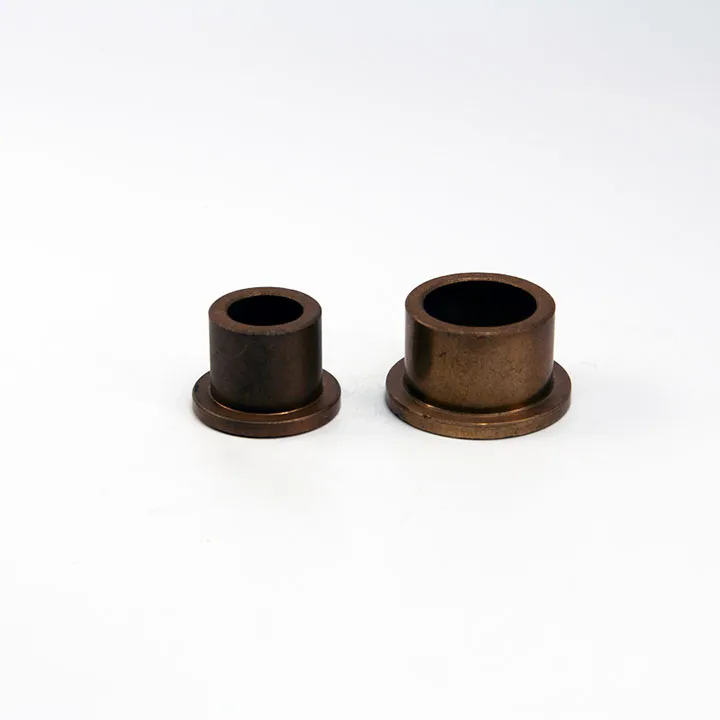
A flanged sintered bushing is a porous plain bearing made by powder metallurgy, with a flange formed on one end of the body.
Like a standard sintered bronze sleeve bushing, the main cylindrical portion supports the shaft. The difference is that the flange adds an axial locating feature. That flange may help:
- stop the bearing at a defined installation depth
- provide axial support against a housing face
- improve assembly positioning
- reduce the chance of the bearing moving too far into the housing
- support light axial load management depending on the application
This is why a flanged bushing is often selected when a plain cylindrical bushing would otherwise need extra parts, shoulders, spacers, or tighter assembly controls to stay in the correct position.
In simple terms:
A plain bushing supports the shaft.
A flanged bushing supports the shaft and also helps locate itself in the assembly.
How a Flanged Sintered Bushing Works
A flanged sintered bushing works on the same porous self-lubricating principle as other sintered bronze bushings.
The bronze powder is compacted into shape and sintered into a rigid porous structure. That structure is then typically impregnated with lubricating oil. During operation, oil retained inside the pore network can migrate toward the shaft-bearing interface, helping support lubrication in suitable service conditions.
The working principle therefore includes two functional layers:
1. The porous bronze bearing function
The cylindrical bore supports the shaft and provides the self-lubricating plain-bearing behavior.
2. The flange function
The flange helps position and support the bushing inside the housing or against a mating surface.
So when engineers choose a flanged sintered bushing, they are usually solving both:
- a lubrication and bearing problem
- an installation and positioning problem
That is what makes the flanged design so useful in practical OEM assemblies.
Why Use a Flanged Bushing Instead of a Plain Bushing?
This is the main question, and the answer usually comes down to assembly logic.
A flanged sintered bushing is often chosen because it makes the installation more controlled. The flange provides a built-in stop or seating face, which can simplify housing design and reduce the risk of positioning errors.
Typical reasons to use a flanged bushing include:
- the bearing must sit at a defined depth
- the assembly benefits from a locating shoulder
- axial movement of the bushing should be limited
- a plain sleeve could drift too far during assembly
- the design needs a wider contact face on one side
- the housing layout is easier with a flange than with an additional retaining feature
In many products, the flange is not just convenient. It is what makes the bushing practical to assemble repeatably at scale.
The Main Practical Advantage: Easier Axial Location
The biggest day-to-day advantage of a flanged bushing is usually axial location.
A plain cylindrical bushing depends on the housing design to determine how far it is inserted. A flanged bushing gives the assembly a natural stop point. This can help:
- reduce assembly variation
- simplify dimensional control
- improve consistency in production
- make service replacement easier
- reduce the need for separate positioning hardware
This matters especially in high-volume OEM production where repeatability is critical.
A part that is easy to place consistently is often much more valuable than a part that is merely cheap on paper.
The Second Major Advantage: More Stable Installation
Because the flange creates a broader seating surface, the installed bearing may feel more mechanically settled in the housing arrangement.
In suitable designs, this can help with:
- improved seating against the housing face
- more defined installation depth
- better resistance to unintended axial movement
- cleaner assembly logic in compact products
This does not mean the flange solves every alignment problem automatically. Shaft fit, bore tolerance, and housing quality still matter. But it often gives the designer a more controlled installation platform than a plain sleeve alone.
The Third Major Advantage: Better Fit for Compact OEM Assemblies
A flanged sintered bushing is particularly useful in compact OEM designs where:
- there is limited room for extra retention features
- the bearing position must be set precisely
- part count should be minimized
- external lubrication is not desirable
- the product is assembled in volume
This is why flanged bushings appear so often in:
- small electric motors
- appliances
- automotive subassemblies
- actuators
- light machinery
- compact mechanical systems
In these products, the flange often helps the bushing do more work without adding more parts.
Common Applications for Flanged Sintered Bushings
The flange becomes most useful when the application needs a bearing that must also hold its place more positively in the housing.
Typical applications include:
Electric motors
Especially small motors where installation depth and low-maintenance operation matter.
Appliances
Where quiet running, compact space, and stable assembly are important.
Automotive mechanisms
Window systems, seat adjustment mechanisms, small actuators, and linkage-related assemblies may use flanged bronze bushings for compact self-lubricating support.
Gear housings and compact drives
Where a shoulder or axial stop is useful without adding extra retaining hardware.
Industrial equipment
Packaging machines, conveyors, small mechanical subassemblies, and other moderate-duty applications often benefit from flange-assisted bearing location.
These are not extreme-duty examples. They are exactly the kinds of products where the flange solves a practical manufacturing and assembly problem.
When a Flanged Bushing Is Better Than a Plain Sleeve Bushing
A flanged bushing is often the better choice when:
- the bushing needs a positive seating face
- insertion depth must be controlled
- axial movement of the bearing should be limited
- the product layout benefits from fewer extra positioning components
- assembly repeatability matters
- the housing design is better suited to a flange-supported arrangement
A plain sleeve bushing may still be the better option when:
- the housing already provides all required axial retention
- the design does not need a flange
- axial space is extremely limited
- the flange adds unnecessary width or complexity
- the part is meant to float or be retained differently in the assembly
So the flange is valuable when it solves a real assembly problem. If no such problem exists, it may not be needed.
What Engineers Still Need to Check
A flanged sintered bushing is not automatically correct just because the assembly has a shoulder or face surface. The same bearing selection rules still apply.
Important factors include:
- shaft load
- speed
- bore fit
- shaft finish
- alignment
- environmental contamination
- operating temperature
- assembly tolerance consistency
In other words, the flange improves installation logic, but it does not eliminate the need for proper bearing selection.
Flanged Bushing vs Other Bearing Options
A flanged sintered bushing is often compared with:
- plain sintered sleeve bushings
- machined bronze bushings
- flanged polymer bushings
- ball bearings in compact assemblies
Its strongest advantages are usually:
- self-lubricating behavior
- compact integrated design
- built-in axial locating feature
- practical cost in volume production
- low-maintenance operation in suitable duty
It may be less attractive when:
- the duty is too demanding for a porous bronze bearing concept
- the design needs a different lubrication strategy
- rolling-element behavior is more appropriate
- the flange geometry no longer helps the product architecture
So again, the right comparison is not “which one is more advanced?”
The right comparison is “which one best matches the product’s real needs?”
Common Buyer and Design Mistakes
Mistake 1: Choosing a flanged bushing only because it looks more secure
The flange should solve a real installation or axial-location problem, not just feel reassuring.
Mistake 2: Ignoring the added flange dimensions
The flange changes packaging and housing-face requirements. It is not a free feature.
Mistake 3: Treating the flange as a substitute for correct fit
Proper shaft and bore design still matter.
Mistake 4: Using a flanged design when the assembly does not need it
In some products, a plain sleeve is simpler and fully sufficient.
Mistake 5: Assuming the flange makes the bearing suitable for heavier duty
The flange helps positioning. It does not turn the bushing into a completely different bearing class.
How to Decide More Reliably
If you are evaluating whether to use a flanged sintered bushing, start with these questions:
Does the bearing need a positive axial stop?
If yes, the flanged design becomes much more attractive.
Is assembly repeatability important?
If yes, the flange may simplify production and reduce variation.
Does the housing design benefit from a seating face?
If yes, a flange often makes practical sense.
Would a plain sleeve require extra retention features?
If yes, the flanged bushing may reduce part count or simplify the design.
Is the application still within the practical duty range of a sintered bronze bearing?
If not, the flange will not solve the more fundamental bearing-selection problem.
FAQ
What is a flanged sintered bushing?
It is a porous self-lubricating sintered bronze bushing with a flange on one end that helps locate and support the bearing in the assembly.
Why use a flanged bushing instead of a plain bushing?
A flanged bushing is often used when the design needs better axial location, more controlled installation depth, or a built-in seating face.
Does the flange carry load?
It may help support axial positioning and seating in the assembly, but the actual bearing suitability still depends on the full application design.
Are flanged sintered bushings self-lubricating?
In many typical designs, yes, they use the same oil-impregnated porous bronze concept as other sintered bronze bushings.
Where are flanged sintered bushings commonly used?
They are commonly used in motors, appliances, automotive subassemblies, actuators, and compact industrial equipment.
Is a flanged bushing always better than a plain sleeve?
No. It is better when the flange solves a real positioning or installation problem. Otherwise, a plain sleeve may be the simpler choice.
Can a flanged bushing replace extra locating hardware?
In some assemblies, yes, that is one of its main practical advantages.
What is the biggest advantage of a flanged sintered bushing?
For many engineers, the biggest advantage is combining self-lubricating bearing behavior with simpler and more repeatable axial positioning in the housing.
Conclusion
A flanged sintered bushing is more than a sleeve bearing with extra material on one end. In many practical designs, the flange is what makes the bearing easier to install, easier to locate, and easier to use consistently in production.
That is why engineers choose flanged sintered bushings when the application needs both self-lubricating bearing support and a more controlled installation geometry. The flange helps solve real assembly problems, especially in compact motors, appliances, actuators, and other OEM products where part count, space, and repeatability all matter.
For technical professionals, OEM customers, and procurement specialists, the best question is not just “what is a flanged sintered bushing?” The better question is “does this assembly benefit from a built-in axial locating feature in addition to the bearing function?” When the answer is yes, a flanged sintered bushing is often the more practical solution.
Engineering Tools for Bushing Selection
If you are evaluating dimensions, fit, or estimated part weight for a sintered bronze bushing project, the following internal tools may be useful during design and quotation review:
Mechanical Design
Calculation Tools